
Summary
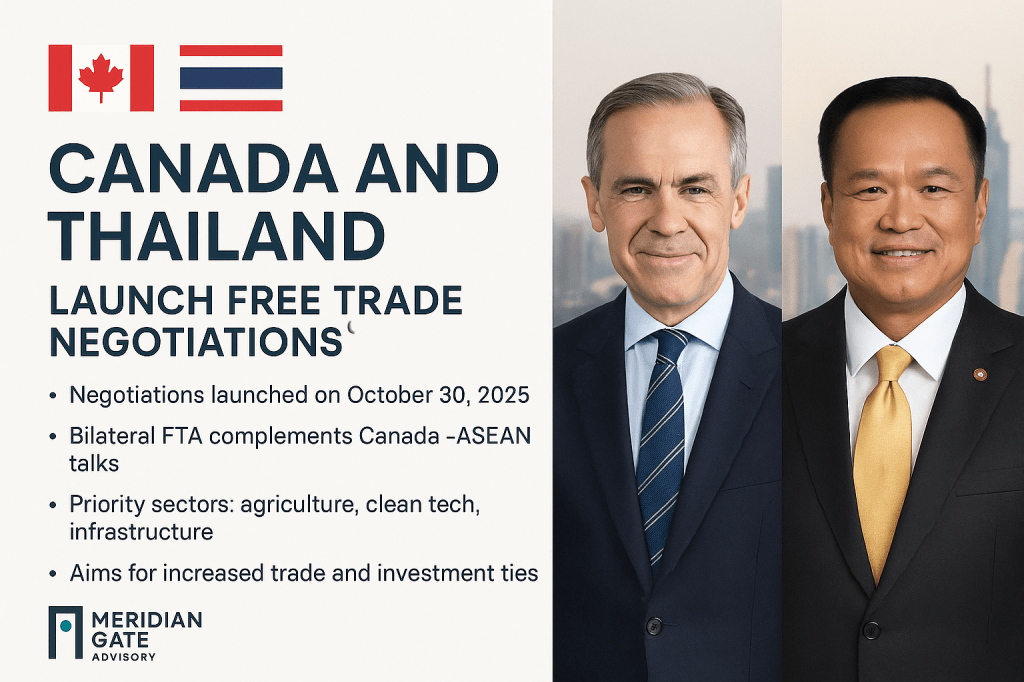
Canada and Thailand have officially launched negotiations for a bilateral Free Trade Agreement (FTA). The announcement followed a meeting between Prime Minister Mark Carney and Prime Minister Anutin Charnvirakul on the margins of the APEC Leaders’ Meeting in Gyeongju, Republic of Korea.
This new initiative complements Canada’s ongoing Canada–ASEAN Free Trade Agreement negotiations, signaling Ottawa’s deeper commitment to strengthening economic integration with Southeast Asia.
According to the Government of Canada, Thailand is currently Canada’s second-largest trading partner in ASEAN, with bilateral trade reaching approximately C$6.4 billion in 2024. Canadian exports to Thailand totaled about C$1 billion, while imports from Thailand amounted to C$5.3 billion.
Key Highlights
- Formal FTA negotiations launched: Both governments agreed to begin work on a Canada–Thailand Free Trade Agreement, designed to strengthen market access, investment protection, and regulatory cooperation.
- Alignment with Canada’s Indo-Pacific Strategy: The move supports Canada’s broader goal of expanding trade diversification across Asia and reducing dependence on traditional markets.
- Priority sectors identified: Discussions emphasized collaboration in agriculture and agri-food, infrastructure, clean technology, and defence cooperation.
- Complementary to Canada–ASEAN FTA: The bilateral deal with Thailand is expected to complement and accelerate the broader ASEAN-Canada FTA talks, now targeted for conclusion in 2026.
Implications for Business and Investment
The launch of Canada–Thailand FTA negotiations represents a strategic expansion of Canada’s trade architecture in Southeast Asia. For businesses, this initiative could:
- Create new opportunities in Thailand’s growing consumer market of over 70 million people.
- Provide tariff reductions and clearer rules for exporters once implemented.
- Strengthen investment confidence through transparent dispute-settlement and investor-protection mechanisms.
- Facilitate collaboration in emerging sectors such as clean energy, logistics, and digital services.
Firms with existing supply chains in Asia should begin assessing how potential FTA provisions may affect sourcing, tariff exposure, and partner eligibility. Early preparation will position companies to capitalize once negotiations advance.
Sources:
Global Affairs Canada – Canada–Thailand Relations
📩 For advisory on trade and investment opportunities under Canada’s Indo-Pacific strategy, contact https://meridiangateadvisory.com/contact/
 Meridian Gate Advisory
Leave a comment